Free · any domain, anywhere · reads only the public TLS handshake

Is your website quantum-safe?

The free first step to post-quantum readiness, for any public domain in the world. KavachQ reads its live TLS handshake, scores how exposed it is to a quantum adversary, and shows where it stands against major banks, governments and technology companies — and against your regulator's deadlines.

Try:
Three patterns · 35 reference sites

Which one is your website?

We scanned the public websites of major banks, governments, technology and payments companies across eight regions. Every one of them fell into one of three patterns.

19of 35 did not negotiate post-quantum key exchange with our probe
10of 35 refuse TLS 1.3, so post-quantum cannot even be switched on
35of 35 still sign with a classical certificate. No public CA issues a post-quantum one yet
Pattern A16 of 35 sites

Post-quantum at the front door

70–82score range
  1. Browser hopSealed on TLS 1.3
  2. CertificateRSA / ECDSA

Browsers negotiate hybrid ML-KEM, usually at a CDN edge, so traffic recorded on that hop stays sealed. The certificate is still classical, and the connection behind the edge is a second session no outside scan sees.

Way outProve the hop behind the edge, refuse TLS 1.2, and plan the certificate move.

Pattern B9 of 35 sites

Modern TLS, classical keys

0–24score range
  1. Browser hopRecordable today
  2. CertificateRSA / ECDSA

TLS 1.3 is on, but the key exchange is X25519 or another elliptic curve on its own. Every session can be recorded now and decrypted once a large quantum computer exists. Nobody has to break in; they only have to keep a copy.

Way outOften a configuration change: enable hybrid X25519MLKEM768 wherever TLS terminates.

Pattern C10 of 35 sites

Stuck before TLS 1.3

0–12score range
  1. Browser hopNo TLS 1.3
  2. CertificateRSA / ECDSA

The server refuses TLS 1.3 outright, and post-quantum key exchange exists only in TLS 1.3. There is no setting to switch on. Until the protocol is upgraded, every session stays classical and can be recorded today.

Way outUpgrade whatever terminates TLS — load balancer, firewall or appliance — and test client compatibility. Hybrid key exchange comes after.
Reference set scanned 9 Nov 2026 with the same engine as your scan. Names are withheld. A site's pattern is set by its key-exchange result alone, so yours is placed by the same rule.

What the scan actually does
01

Reads the handshake

We negotiate a standard TLS connection — exactly what your browser does — and read the certificate and protocol versions the server offers. Read-only, no login.

02

Scores the exposure

The engine maps each algorithm against Shor's and Grover's reach, weighs harvest-now-decrypt-later risk, and returns a PQC-Ready score — which the report recomputes from the CBOM and shows line by line.

03

Cites the regulator

The report detects the jurisdiction from the certificate and domain and counts down to that regulator's next PQC milestone — India, the US, the UK, the EU, Saudi Arabia, the UAE, Singapore and Australia. World tracker →

We only read what is publicly negotiated in a TLS handshake — no login, nothing stored. If a CDN or hosting provider terminates TLS for the domain, the result names it: the score then grades that provider's edge, not the systems behind it. The full report, which we email on request, adds every finding, the full inventory and chain detail, a sequenced remediation roadmap and a PDF; the signed CBOM and dependency graph come with an estate assessment.

Beyond a single domain

Your scan reads one domain. The console maps the whole estate.

The free scan inspects one site's public TLS handshake. Inside KavachQ, every scan folds into a single, deduplicated inventory of the certificates and algorithms you run — each one scored, tiered, and mapped to its post-quantum replacement. These are real console screens, captured on a demo tenant; the numbers are illustrative and client identifiers are omitted.

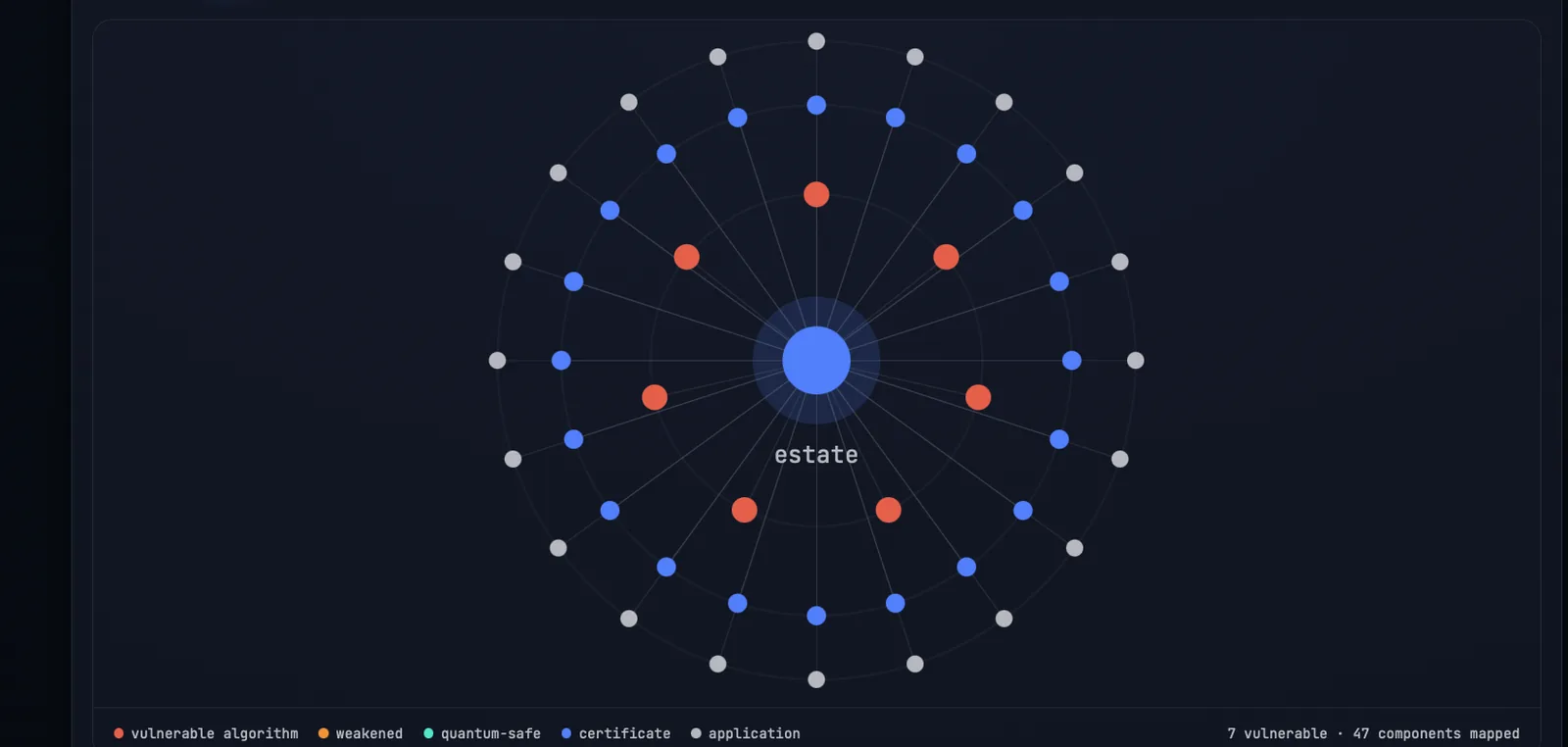
KavachQ · CBOM map
KavachQ console — CBOM map plotting each estate asset as a node coloured by quantum risk: vulnerable, weakened, or quantum-safe.
The estate as a CBOM. Each certificate and algorithm you run, plotted by quantum risk — vulnerable, weakened, or already quantum-safe.
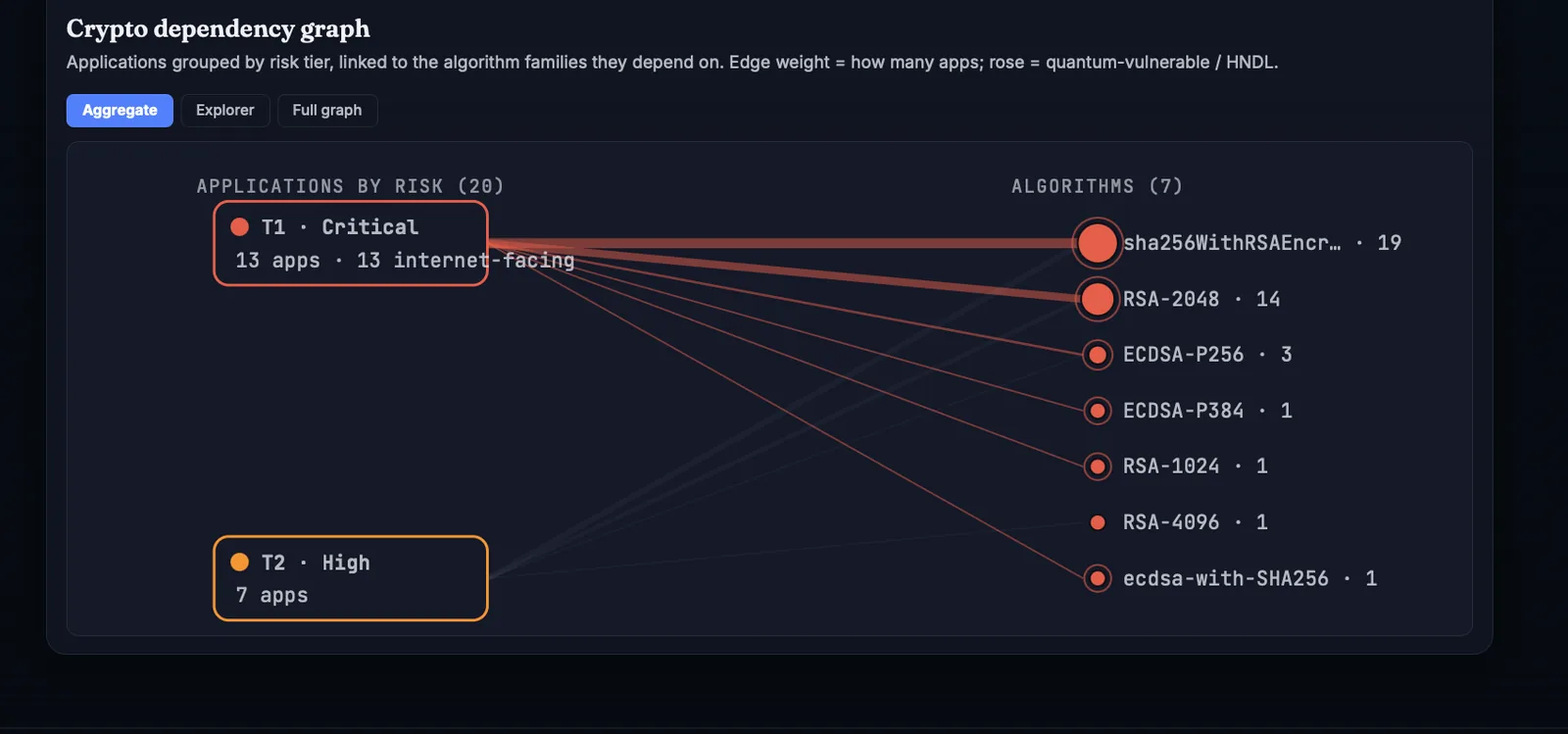
KavachQ · Dependency graph
KavachQ console — crypto dependency graph linking application risk tiers to the vulnerable algorithm families they depend on.
Crypto dependency graph. Which applications, grouped by risk tier, lean on which quantum-vulnerable algorithm families.

Captured from the working KavachQ console on a demo tenant · illustrative data · client identities blurred or omitted.

Full report · free

Get the full report for

We check each request and email the full report and PDF, usually within one working day. Requests from an email on the scanned domain go first. A KavachQ specialist may follow up to walk you through it.

Where should we reach you?

We keep your details, the domains you scan from this browser, and the scan results, to follow up on them. Nothing is shared. Privacy notice.