Built around the standards India's regulators are aligning to
One platform for the whole migration journey
Find it, fix it, prove it — from "we don't know what crypto we run" to a board-ready, DST-aligned migration plan and signed evidence. See the products →
See every certificate, algorithm, and key parameter you run
KavachQ builds a Cryptographic Bill of Materials (CBOM) across your estate — TLS endpoints, certificates, and protocols, plus any CBOM you already hold — so quantum-vulnerable cryptography stops hiding in plain sight.
Scan a domain freeKnow which assets are exposed first
Every asset gets a T1–T4 risk tier — algorithm strength, exposure, and harvest-now risk — and the estate a 0–100 readiness score. A single, ranked risk register tells you exactly what to fix first — not a flat list of findings.
Try the live risk modelSequence the move — with crypto-agility built in
Generate a phased, impact-aware migration to ML-KEM, ML-DSA, and SLH-DSA — mapped to the apps each change touches. Designed so the next algorithm swap is a config change, not a project.
Explore the roadmapBoard-ready, DST-aligned evidence
Export a board pack tagged to DST/NQM milestones and the relevant RBI / SEBI / CERT-In references, with a CBOM signed with ML-DSA-65 (FIPS 204) that an auditor can check offline.
See the framework- Inventory frozenCBOM baseline · 1,284 assets
- Pilot ML-KEM-768TLS termination · staging
- Hybrid rolloutX25519 + ML-KEM · production
- Signatures → ML-DSA-65code-sign + mTLS
- Decommission RSA/ECCcrypto-agility verified
Product screens are illustrative.
Not a mockup. The working console.
The walkthrough above is illustrative. These are the actual KavachQ console screens — captured on a demo tenant, with illustrative numbers and client identifiers blurred or omitted. Real client estates never leave your environment.
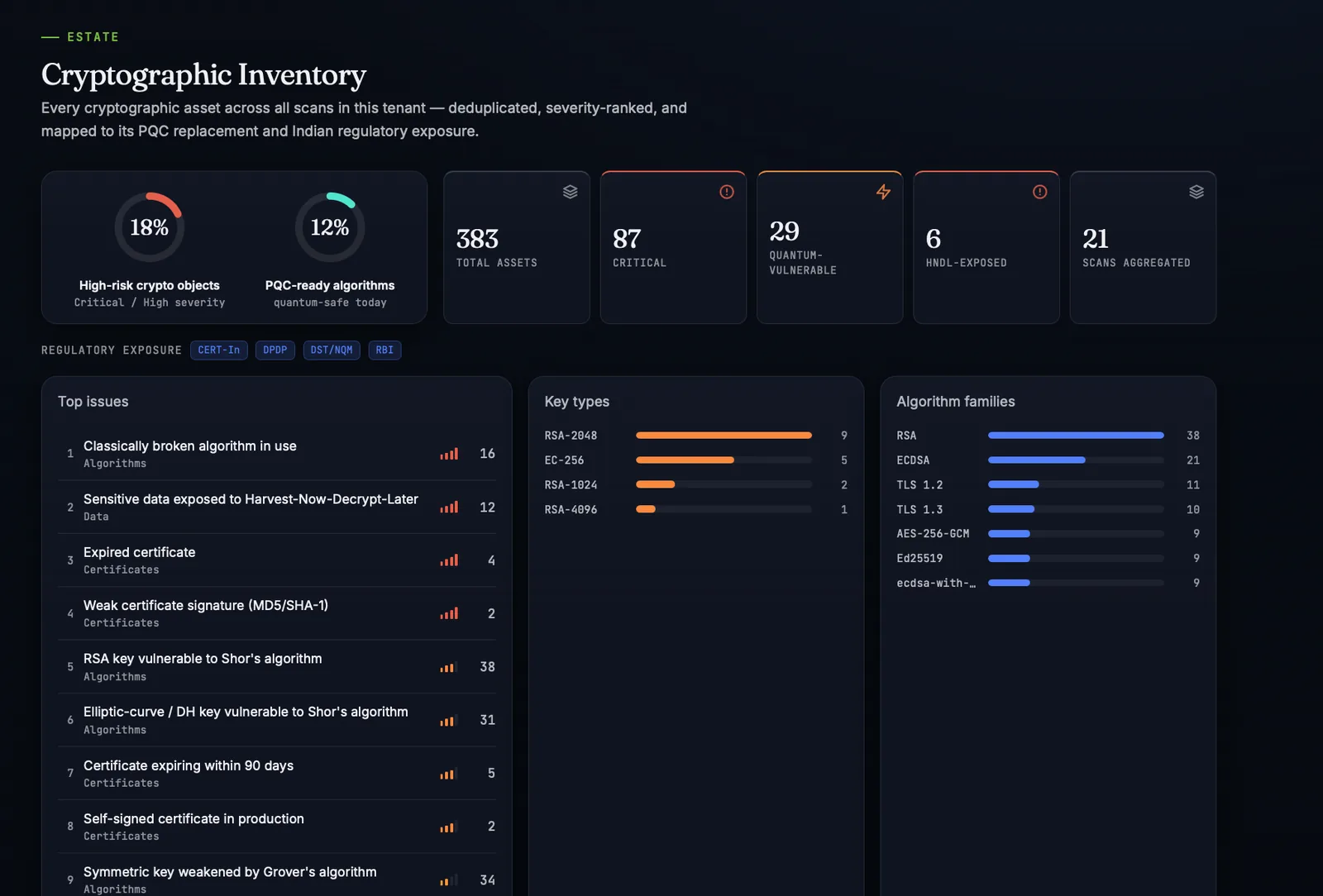
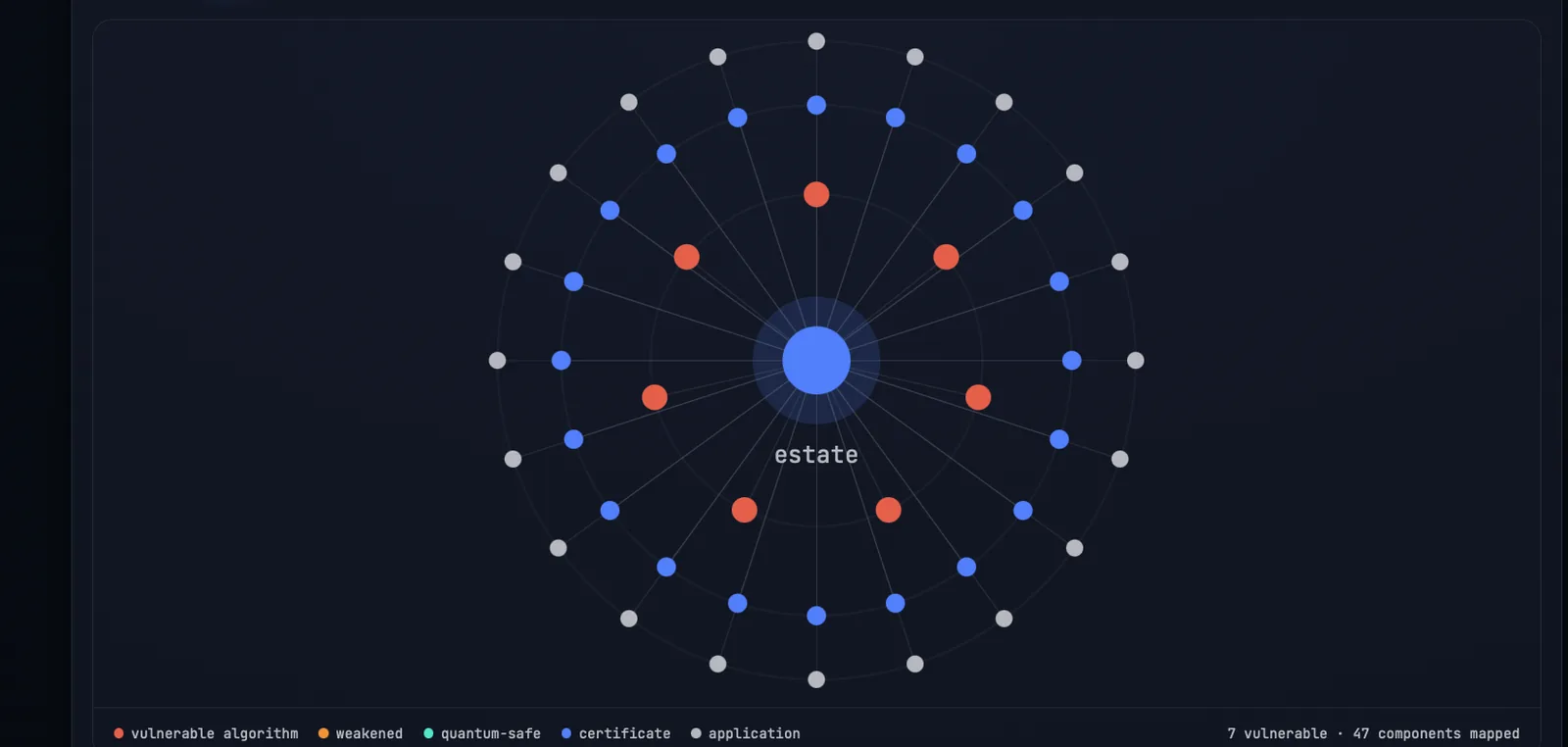
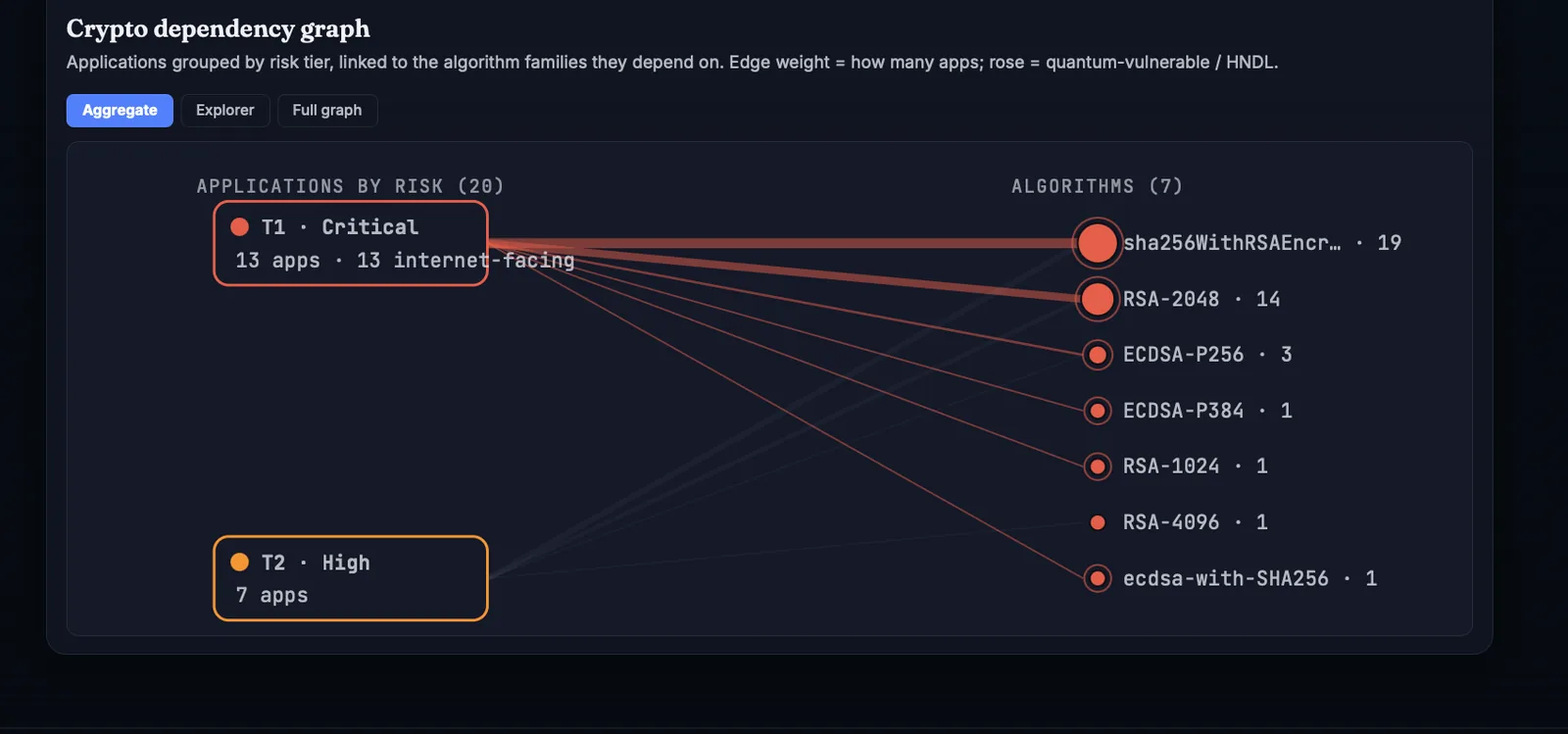
Captured from the working KavachQ console on a demo tenant · illustrative data · client identities blurred or omitted.
If X + Y > Z, your data is already at risk
Drag the sliders. X — how long this data must stay secret. Y — how long migration takes. Z — when a cryptographically-relevant quantum computer arrives.
X + Y exceeds Z — your shelf-life data is exposed before migration finishes. Move from awareness to inventory in the next 6–9 months.
Is your website quantum-safe?
Scan any domain's live TLS handshake for quantum-vulnerable certificates — and get its post-quantum readiness score instantly.
We only read what's publicly negotiated in a TLS handshake — no login, nothing stored.
The cryptographic sandbox
Run a hybrid-PQC or NIST post-quantum handshake and watch the negotiation, step by step.
India has set the clock.
The migration takes years, not months.
Advisory target — DST National Quantum Mission Task Force roadmap: CII to reach full PQC by 2029. Not a regulatory deadline.
The NQM Task Force sets advisory targets for Critical Information Infrastructure to reach post-quantum resiliency by 2029, and enterprises by 2033. Adversaries are already harvesting encrypted traffic to decrypt later. Starting discovery today is the only way to finish in time.
The harvest-now threat is real
Adversaries are intercepting and storing encrypted traffic today. Data with long-term sensitivity (financial, health, defence) is already compromised in principle. Quantum-safe migration cannot wait.
Quantum advantage is approaching
Google's Willow chip achieved below-threshold error correction in 2024. IBM, Microsoft, and others have published credible roadmaps to fault-tolerant systems within this decade.
India has published a clear roadmap
The NQM Task Force sets advisory targets for CII to reach full post-quantum resiliency by 2029, and enterprises by 2033. Migration takes years, not months. Delay now means compressed timelines later.
CBOM evidence is already in tenders
At least one public-sector bank tender on GeM (Punjab & Sind Bank, 2026) requires vendors to submit CERT-In-aligned SBOM and CBOM evidence — quarterly, penalty-backed. Crypto inventory is moving from good practice to a condition of doing business.
From understanding to operational readiness
A complete journey — executive education, live scanning, maturity assessment, and migration planning.
Quantum Risk Scan
Scan any domain's TLS handshake for quantum-vulnerable certificates and get a PQC-readiness score in seconds.
Migration Roadmap
The NQM advisory timeline with two adopter tracks — CII (2027–29) and Enterprise (2028–33) — and key milestones.
Maturity Scan
A board-ready maturity score across awareness, inventory, risk, agility, and supplier discipline.
Cryptography Explorer
Compare NIST FIPS 203/204/205 algorithms by size, speed, family, and recommended use case.
KavachQ Platform
CBOM discovery, quantum risk scoring, migration planning, and DST-aligned reporting in one place.
World Tracker
Track PQC mandates and regulatory deadlines across major economies, updated as policy moves.
Credibility, not claims
We're an early team, so here's exactly what we stand on today.
Standards-first
Built around NIST FIPS 203 (ML-KEM), 204 (ML-DSA) and 205 (SLH-DSA), mapped to the DST National Quantum Mission roadmap and its migration milestones.
Evidence you can verify
Every CBOM export is signed with ML-DSA and verifiable offline — an auditor can check the evidence without access to your estate.
Indian, by design
Built by V Innovation Labs in India, for India's BFSI and Critical Information Infrastructure.
Open & auditable
CBOM output in open CycloneDX 1.7 — portable evidence your own auditors can reproduce, with no lock-in.
Four pillars of India's quantum strategy
India's NQM — approved in 2023 with ₹6,003.65 crore — anchors research across four IIT/IISc hubs. KavachQ focuses on the cryptography that protects everything built on top.
Quantum Computing
Quantum computing T-Hub at IISc Bengaluru: scalable quantum processors.
Quantum Communication
Satellite-based QKD, trusted-node architecture, and a sovereign communication backbone.
Quantum Sensing
Precision magnetometers, gravimeters, and optical atomic clocks for defence and navigation.
Quantum Materials
Semiconductors, topological insulators, and superconductors — the foundational hardware layer.
States leading India's quantum ambition
Beyond the NQM, four Indian states have launched quantum-technology policies with infrastructure, funding, and talent programmes.
Amaravati Quantum Valley
Policy 2025–30A dedicated quantum technology park in Amaravati. MoU with IBM, TCS and L&T (May 2025) for a 156-qubit IBM Quantum System Two. AP Quantum Computing Policy 2025–30.
Karnataka Quantum Mission
₹1,000 CrLaunched 2025, targeting a $20 billion quantum economy by 2035. Coordinated through KITS (Karnataka Innovation & Technology Society) and a state Quantum Task Force.
Quantum Corridor
Corridor MoUTripartite agreement with IonQ and Scandian AB for a quantum corridor. Letter of Intent with IBM on a state quantum computing initiative.
Quantum Hardware Access
State-backediTNT Hub signed a Letter of Intent with XeedQ (Umagine 2026) for remote access to a 4-qubit XeedQ machine for students and startups, run from iTNT Hub at Anna University, Chennai.
Post-quantum cryptography in India — the essentials
Straight answers to what BFSI and Critical Information Infrastructure teams ask most about PQC migration.
What is post-quantum cryptography (PQC)?
Why do Indian banks and BFSI need to migrate to PQC now?
What is the DST / National Quantum Mission PQC deadline for India?
What is the difference between PQC and QKD?
How do I check whether my organisation is quantum-safe?
Make your quantum readiness provable
Understand the landscape. Assess your exposure. Leave with a board-ready, DST-aligned plan — and signed evidence a regulator or auditor can verify. KavachQ takes you from awareness to proof.