The free scan, start to finish
Enter a public domain and get its PQC-Ready score, what is exposed and what to fix first. Our own domain, kavachq.in, scores 82 out of 100. Open our live report →
Inside the console
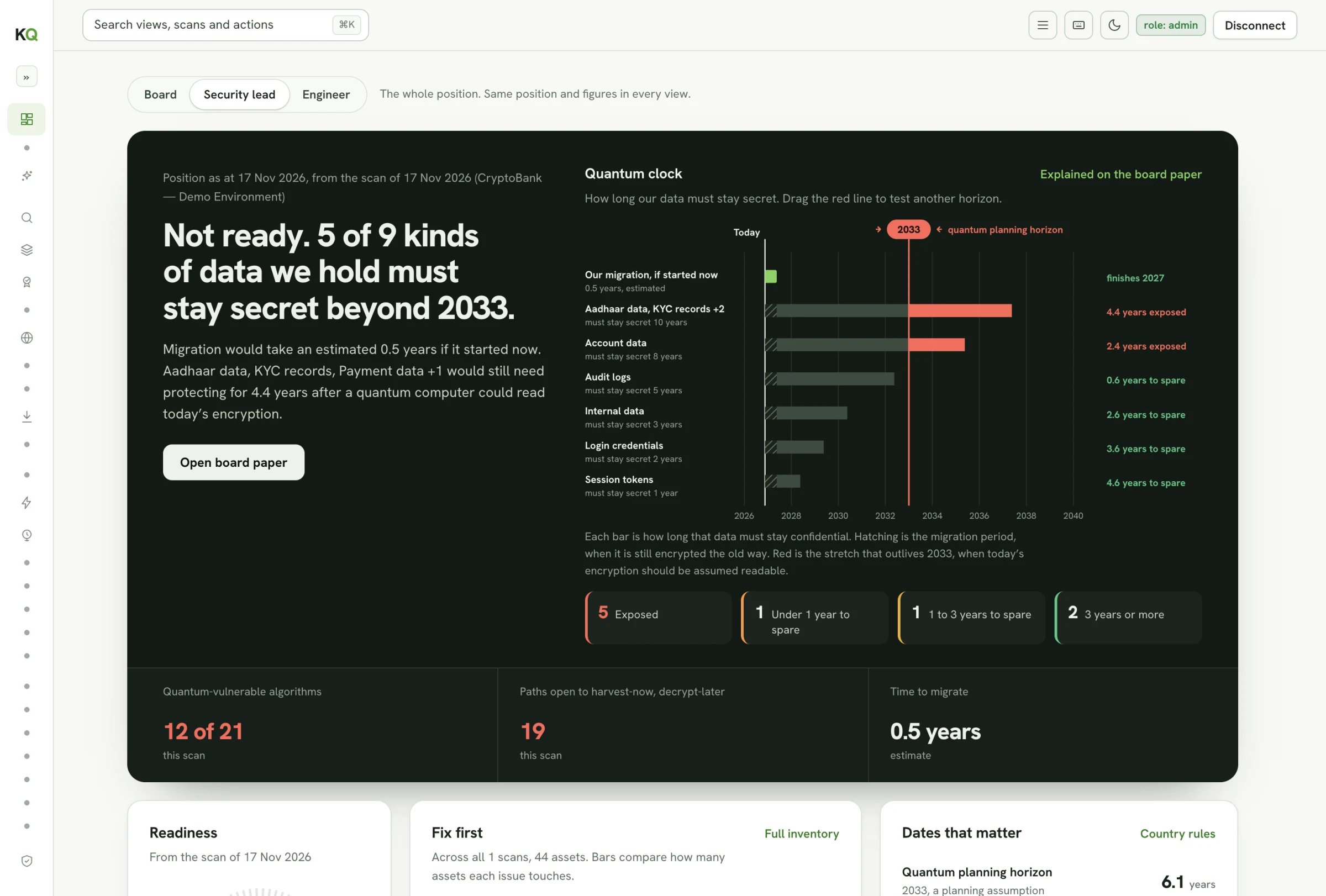
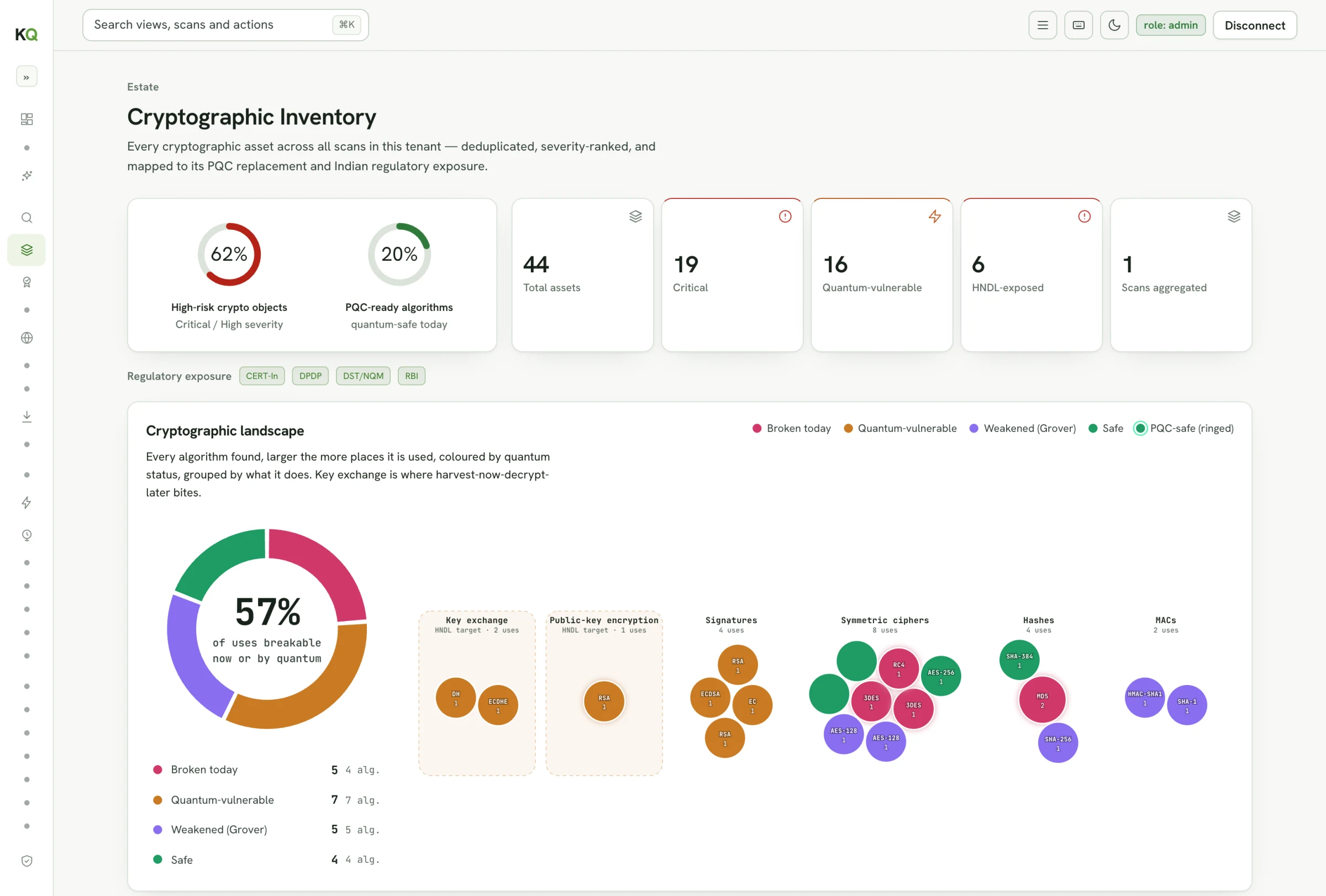
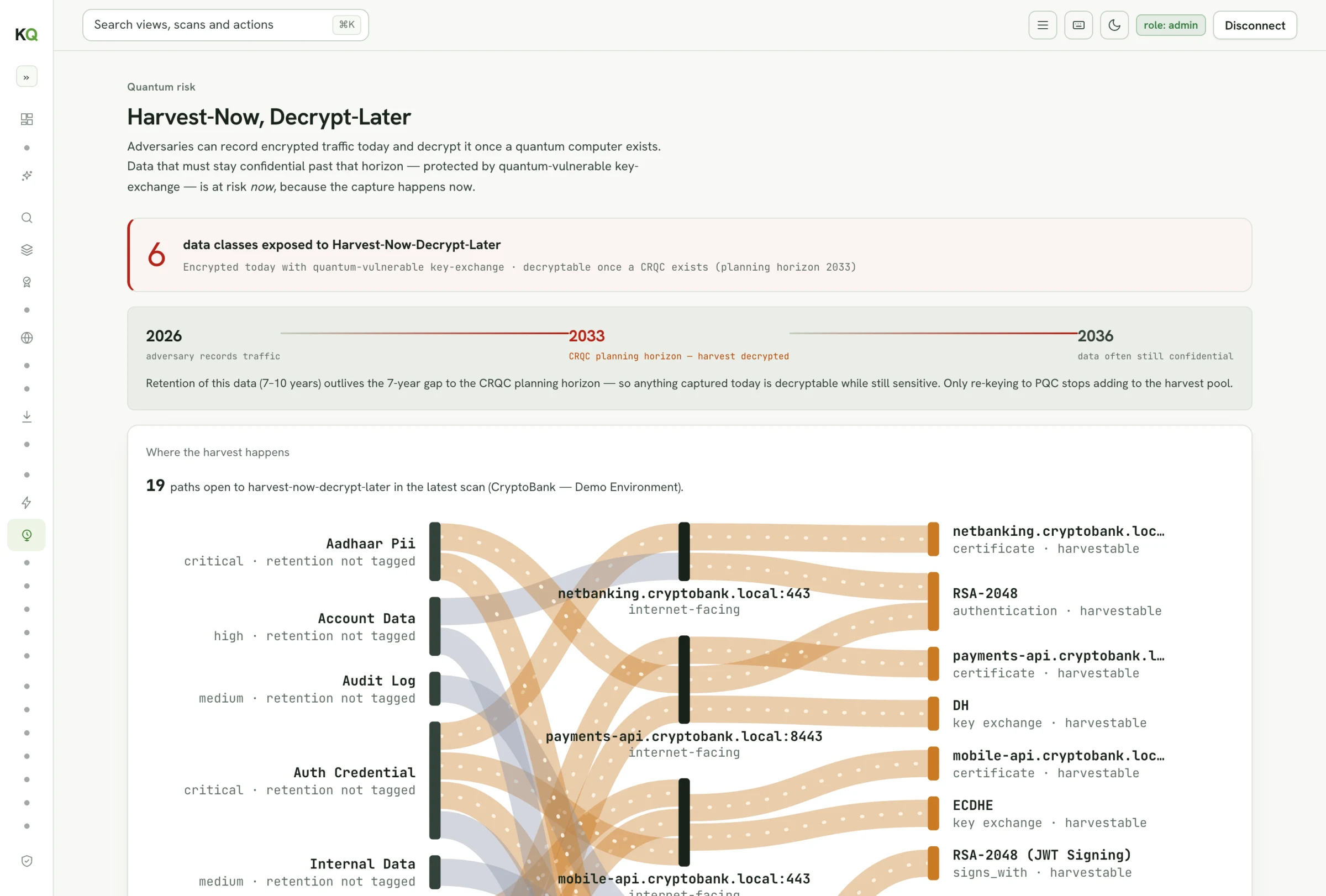
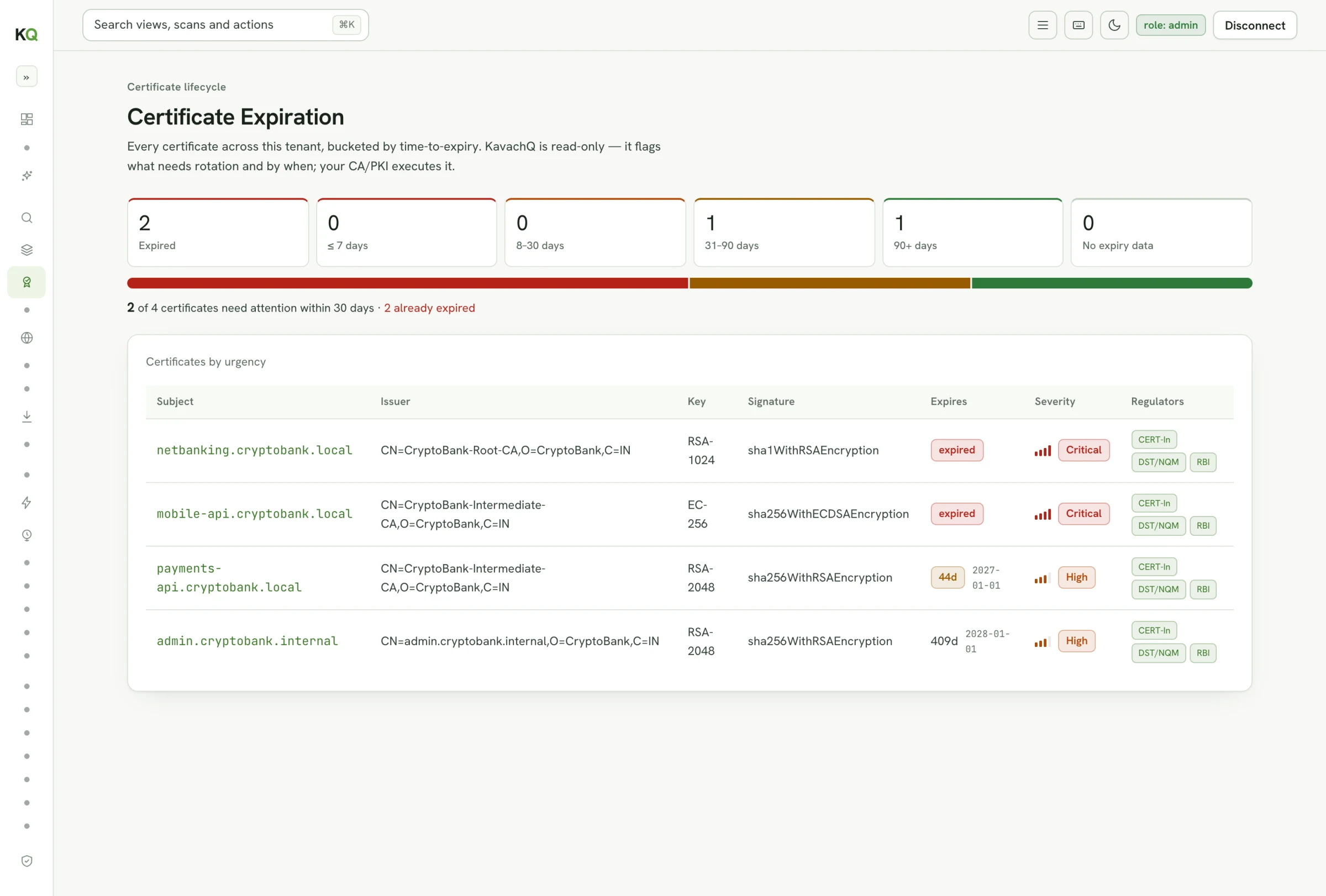
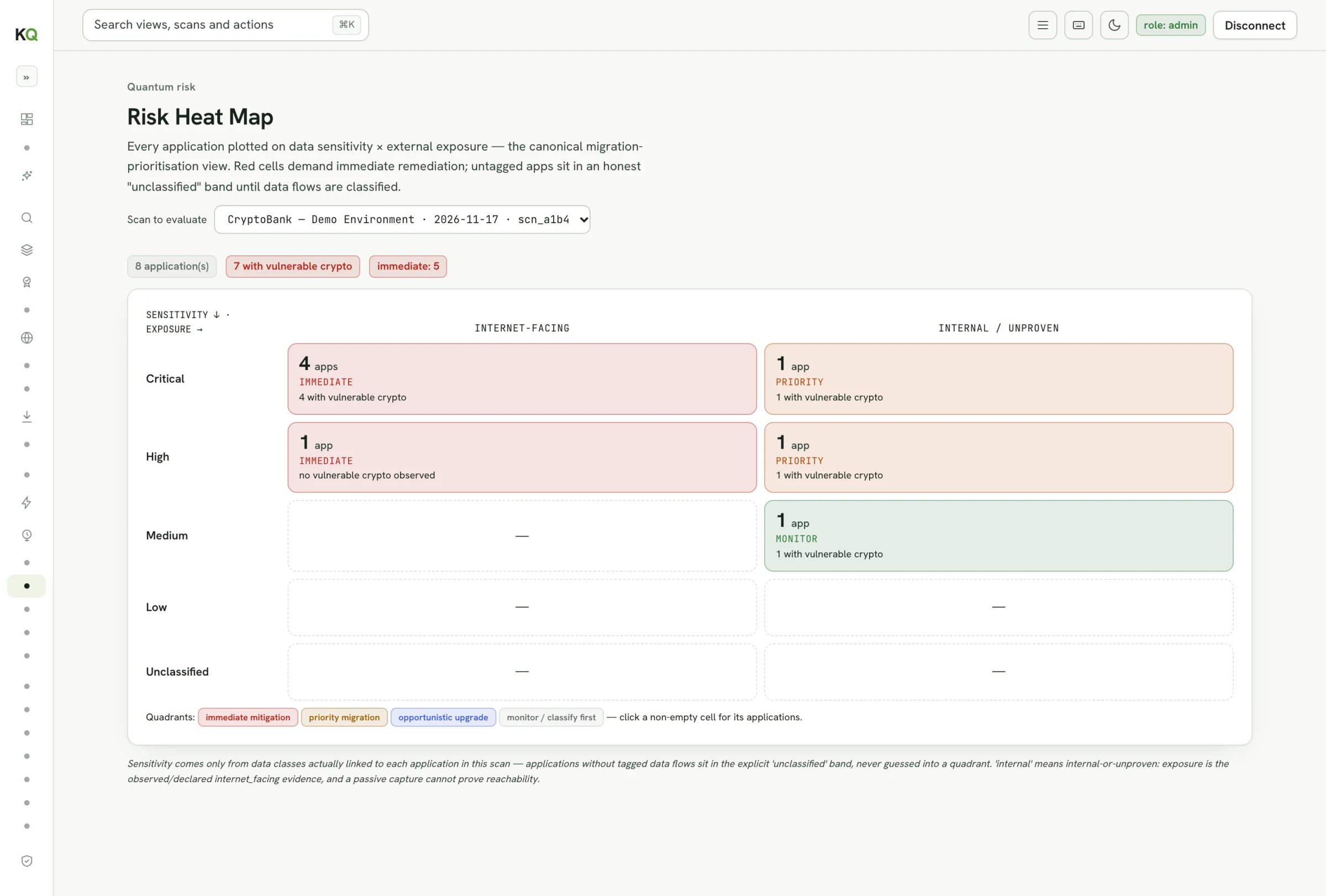
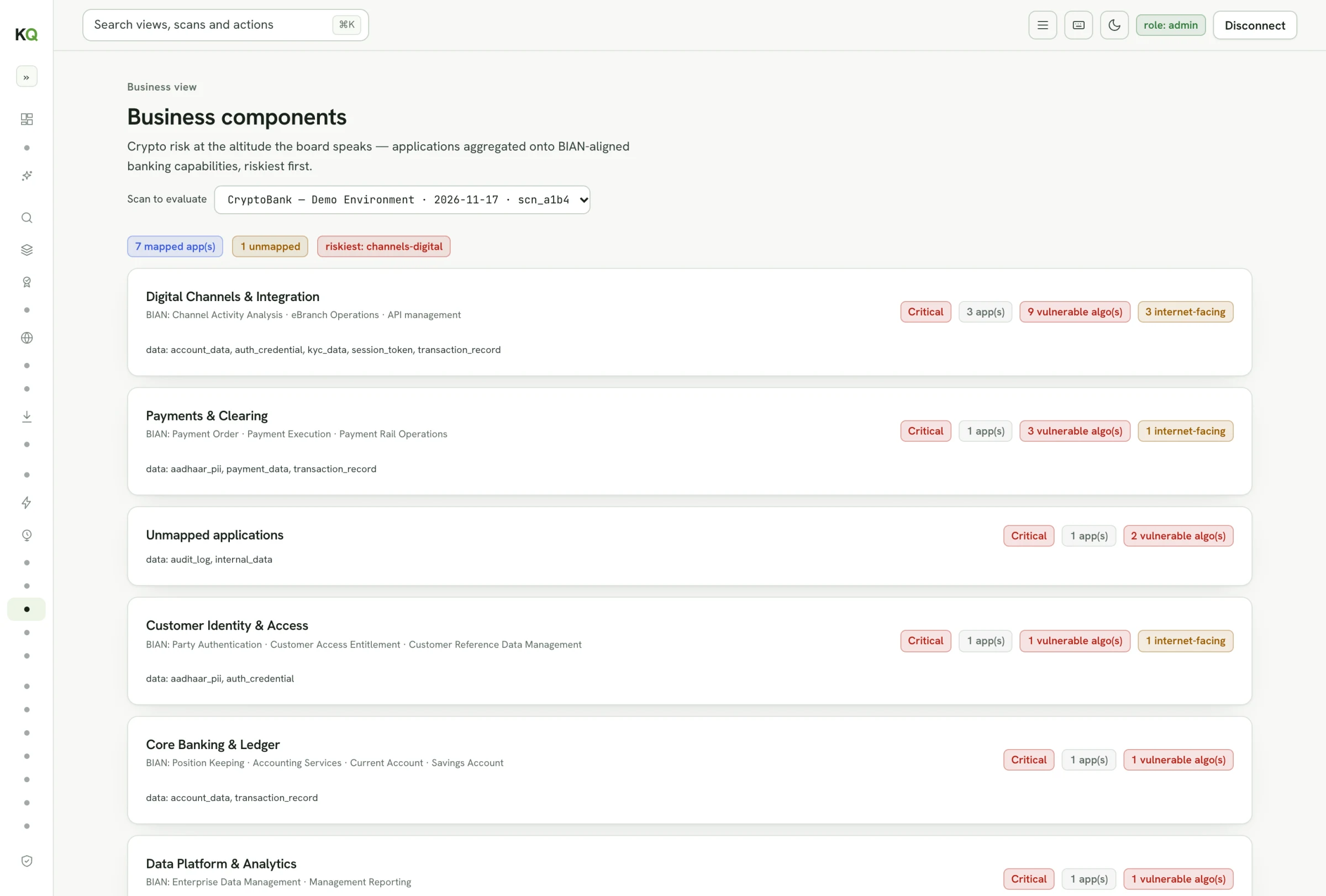
The scan reads one public endpoint. The console maps a whole estate. These screens are from the current console build, captured on 18 November 2026 on a small synthetic demo bank, so no client data appears.
Why now
The data you encrypt today has a shelf life
Adversaries can store encrypted traffic today and decrypt it once a cryptographically relevant quantum computer exists. Data that must stay secret for years is exposed in principle already.
On screen: your estate on the left, and copies of its traffic piling up in an adversary's archive on the right. Illustrative; nobody knows when that computer will arrive.
The standards are final
NIST published FIPS 203, 204 and 205 in August 2024. Browsers and CDNs already negotiate hybrid post-quantum key exchange by default.
Regulators have set dates
Saudi Arabia wants a cryptographic inventory by the end of 2026. Targets in the EU, Australia and the US follow in 2030. See yours →
Migration takes years, not months
Large estates carry thousands of certificates, embedded keys and third-party dependencies. Every programme starts with an inventory. Work out your exposure →
Find it. Fix it. Prove it.
Three KavachQ products run in order on the same estate, and a fourth protects what you cannot change yet. Keep scrolling to watch each step.
- 1Find itKavachQ Discover inventories your cryptography and ranks the risk.
- 2Fix itKavachQ Migrate plans every change and applies the TLS ones after approval.
- 3Prove itKavachQ Seal signs the evidence so anyone can verify it.
Have an application you cannot change yet? KavachQ Gateway puts post-quantum TLS in front of it →
Step 1 of 3 · Find it · KavachQ Discover
Know every lock a quantum computer can open, and which to change first
KavachQ Discover builds a Cryptographic Bill of Materials across your estate, gives every asset a T1–T4 risk tier and gives each scan a 0–100 PQC-Ready score.
On screen: every asset sorted into rings by risk tier, with the most urgent at the centre.
Explore KavachQ Discover →Step 2 of 3 · Fix it · KavachQ Migrate
Change it safely, and check that the change took
KavachQ Migrate turns findings into a phased plan and prepares change packs for nginx, HAProxy, Apache and ACME. It applies them only after a named approver signs off, with a tested rollback.
On screen: the same assets after migration. Each label shows what replaced the old algorithm.
Illustrative assets. Migrate changes TLS terminators only; everything else leaves as a planned, tracked task.
Explore KavachQ Migrate →- nginx · payments-api: RSA key exchange (t1 · at risk) → Hybrid ML-KEM: changed
- Code signing: RSA-2048 (vulnerable) → ML-DSA-65 · P1: planned
- Inventory: Unknown crypto (blind spot) → 1,284 assets: signed
- HAProxy · api-gw: TLS 1.2 · RSA (t1 · at risk) → TLS 1.3 + ML-KEM: verified
- core-banking: 3DES (broken) → AES-256 · P0: planned
- Certificate · *.bank: Expires in 9 days (expiring) → ACME renewal: renewed
- vpn-gw: ECDH P-256 (harvest-now) → Vendor-blocked · P1: tracked
- Regulator request: No evidence (exposed) → CBOM · ML-DSA-65 signed: verifies offline
- Apache · portal: ECDHE · X25519 (vulnerable) → Hybrid ML-KEM: changed
- Vendor SBOM: Unsigned PDF (unverified) → Imported & merged: in the graph
- Change window: Manual edit (no rollback) → Named approver: rollback tested
- Board pack: Spreadsheet (unsigned) → Readiness certificate · ML-DSA-65: signed
Step 3 of 3 · Prove it · KavachQ Seal
Proof anyone can check, without trusting us
KavachQ Seal signs every CBOM with ML-DSA-65 (FIPS 204). An auditor, a regulator or a tender committee can verify it offline against the signing key's published fingerprint.
On screen: the finished inventory sealed into one signed record.
Explore KavachQ Seal →What does your regulator expect, and when?
Pick a jurisdiction. Every milestone links to its primary source.
Every regulator asks for the same first evidence: an inventory, a risk ranking and a migration plan. More detail: India hub, Saudi Arabia & the GCC, India BFSI Readiness Index, World Tracker.
- 31 Dec 2026
- Saudi Arabia · SAMA inventory due
- 2030
- EU high-risk · Australia RSA/ECC cut-off · US federal key exchange
- 2035
- UK, EU and US end-state targets
- 3 NIST
- FIPS 203, 204 and 205: the standards we plan against
CERT-In asks for five bills of materials
India's CERT-In Technical Guidelines v2.0 (9 July 2025) set minimum elements for software, cryptographic, quantum, AI and hardware BOMs, and bank tenders now ask suppliers for them.
Our research · 26 August 2026
Of 66 Indian financial institutions we measured, 42% have started. 3% have finished.
We read the public TLS handshake of 66 Indian banks, insurers, NBFCs, payment rails and regulators, the same handshake a browser performs when it loads their homepage.
- 66
- institutions measured
- 28
- negotiate hybrid post-quantum key exchange
- 26
- of those 28 still accept TLS 1.2, where sessions fall back to classical key exchange
- 2
- serve TLS 1.3 only, with no classical path left open
Check it yourself
We're an early team, so don't take our word for any of this. Each item below is something you can test without talking to us.
This site's own key exchange
This site is served over hybrid post-quantum key exchange. Any TLS client shows the negotiated group:
openssl s_client -connect kavachq.in:443 -servername kavachq.in </dev/null \
  | grep "Negotiated TLS1.3 group"
Negotiated TLS1.3 group: X25519MLKEM768
OpenSSL builds without ML-KEM support will not print the group. Watch a hybrid handshake step by step →
Our signing key
Every KavachQ CBOM is signed with ML-DSA-65 (FIPS 204). The active public key is published, so a signature verifies offline against its fingerprint:
db8cbed472406e9968f38a1212b962f4
fe4a03059d9d89434ce97a70cef684b3What the output looks like
Evidence is open CycloneDX, so it is portable and there is no lock-in. Download example files and open them in any CycloneDX tool:
Examples with illustrative data. The CBOM evidence standard →
Where it runs and what it can change
KavachQ runs in your VPC, on-premises or air-gapped, as a self-hosted deployment, and stores none of your keys. Only Migrate changes systems: TLS terminators only, after a named approver on your side signs off.
Common questions about post-quantum migration
What is post-quantum cryptography (PQC)?
A family of encryption and digital-signature algorithms designed to stay secure against both classical and quantum computers. In August 2024 NIST finalised the first three standards — ML-KEM (FIPS 203), ML-DSA (FIPS 204) and SLH-DSA (FIPS 205). They run on today's hardware and replace RSA and elliptic-curve cryptography.
Why migrate now, if quantum computers that break RSA don't exist yet?
Two reasons. Adversaries can harvest now and decrypt later, so long-lived data is already exposed. And migration takes years: regulators including the UK NCSC, Australia's ASD, the EU and the Saudi Central Bank have set milestones between 2026 and 2035. Find yours →
What is a CBOM, and why do regulators ask for one?
A Cryptographic Bill of Materials is an inventory of every algorithm, key, certificate and protocol you use, and where. You can't migrate what you can't see, so it's the first thing SAMA, NCSC, ASD and the EU roadmap ask for. KavachQ produces CBOMs in open CycloneDX 1.7, signed with ML-DSA. Read the CBOM guide →
What is the difference between PQC and QKD?
PQC is software — quantum-resistant algorithms that run on existing hardware. Quantum key distribution (QKD) is hardware that exchanges keys over dedicated fibre or satellite links. For most enterprise migration, NIST PQC is the practical, standards-based path; QKD complements it on specific high-assurance links. Read the comparison →
Where does KavachQ run?
Where your regulated data lives — in your VPC, on-premises, or air-gapped as a self-hosted deployment. Client estates never leave your environment. See the deployment guide →
Make your quantum readiness provable
Start with one domain, or scope a pilot on a slice of your estate. Leave with an inventory, a ranked risk register, a migration plan matched to your regulator's dates, and signed evidence an auditor can verify.
- A phased migration plan sequenced against your regulator's milestones
- Signed CycloneDX CBOM evidence an auditor can verify offline
- Runs in your VPC, on-premises or air-gapped
Prefer email? demo@kavachq.in
Thank you — it's with the team.
We'll reply from demo@kavachq.in. Meanwhile, see where your public endpoints stand:
Run the free scan