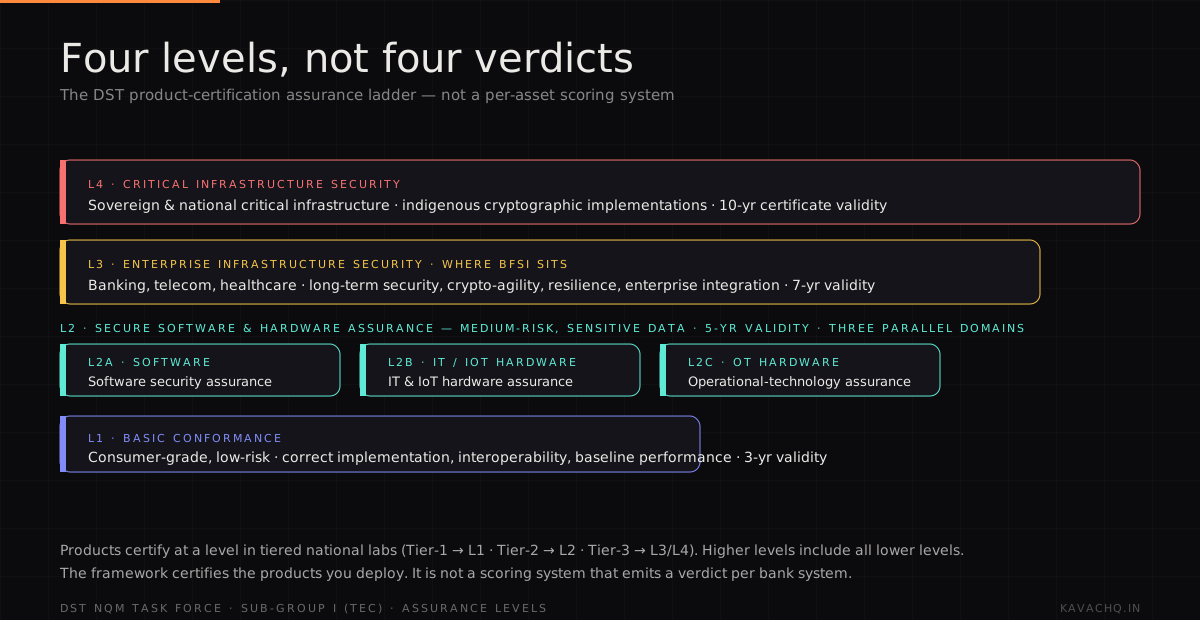
The DST National Quantum Mission Task Force — through its TEC-led sub-group — has produced a "Framework for Testing and Certification of PQC based Quantum-Safe Products and Solutions". It defines four hierarchical assurance levels, L1 to L4, at which the PQC products an institution deploys are tested and certified, with the middle level split into three parallel domains (L2A, L2B, L2C). The framework gives regulators, testing labs, vendors, and CISOs a shared ladder for asking how deeply has this product been assured and what deployment contexts is it fit for.
That's the use it was designed for. The misuse — common enough in PQC pitch decks to be worth calling out — is reading the framework as a scoring system that assigns each individual asset in a bank a verdict. It is not that, and treating it that way produces unreliable reports.
What each level names
From the bottom up, the levels cover increasing depth of assurance, matched to the risk of the deployment context. Each certification carries a validity period that lengthens with the level (three years at L1, up to ten at L4), and higher levels include compliance with all lower ones:
- L1 — Basic Conformance. For low-risk, non-sensitive, consumer-grade environments. Testing focuses on correct implementation of the PQC algorithms, interoperability, and baseline performance. Certificate validity: three years.
- L2 — Secure Software and Hardware Assurance (L2A / L2B / L2C). For medium-risk deployments handling sensitive data. The three sub-levels are parallel domains at one level, not ascending ranks: L2A covers software security assurance, L2B IT and IoT hardware assurance, and L2C operational-technology (OT) hardware assurance. Certificate validity: five years.
- L3 — Enterprise Infrastructure Security. For high-risk, enterprise-grade environments — the report names banking, telecom, and healthcare. Testing focuses on long-term security, crypto-agility, resilience, and enterprise integration. This is the level most BFSI deployments sit at. Certificate validity: seven years.
- L4 — Critical Infrastructure Security. For very high-risk, sovereign, and national critical infrastructure. The focus shifts to indigenous cryptographic implementations and hardware — reducing dependence on external validation ecosystems and strengthening sovereign assurance. Certificate validity: ten years. The report's level table names critical information infrastructure protection as the L4 context, and BFSI is one of the report's CII sectors — so CII-designated banking systems may need L4.
Certification happens in a tiered national laboratory structure: Tier-1 labs conduct L1 testing, Tier-2 labs handle the L2 domains, and Tier-3 labs run the advanced L3 and L4 evaluations.
Descriptive, not a scoring system
The framework defines certification levels for products; it does not define a verdict per asset. The distinction matters because a CISO who reads "L1 to L4" and thinks this asset got an L3, that asset got an L2 is reading something that isn't there.
What the framework actually says is: a product certified at level Y is fit for deployment contexts of risk X. Whether a specific bank's estate is running certified products, and where its migration stands, are separate questions. The framework gives a vocabulary for those questions; it doesn't answer them.
This matters for reporting in particular. Aligned reporting means framing deliverables against the report's structures — its three milestones for progress (Milestone 1, Building the Foundations; Milestone 2, Migration of High-Priority Systems; Milestone 3, Resiliency for all systems — M1/M2/M3 below), and the assurance ladder for procurement — so a regulator reading the report can see, at a glance, where the estate stands and what the products being deployed will need to certify at. It does not mean emitting an L1/L2/L3/L4 label per asset. The first is structurally useful; the second is structurally noisy.
How a useful framework-aligned report is shaped
A migration-progress report aligned to the DST framework looks like:
- Inventory. What cryptography the estate runs, by system class — the CBOM baseline the report's first milestone asks for.
- Milestone progress. Where the estate stands against the report's M1/M2/M3 milestones: migrated, in progress, not yet started. Diffable quarter-over-quarter.
- Exceptions. Systems that cannot move this quarter, why, and the compensating control or sunset plan.
- Procurement alignment. The PQC products being deployed and the assurance level each will need to certify at (for BFSI, L3) once the testing-lab ecosystem stands up — plus the dependencies: HSM procurement, vendor commitments, PKI rotations, budget.
That structure works for board reporting, for regulator reporting, and for cross-organisation conversations with sector peers. Asset-level verdicts work for none of those — they're the wrong granularity for the audience.
What to do this quarter
If the framework is new for your team:
- Inventory your top 30 systems' cryptography. Don't try to inventory everything immediately. Pick the operationally critical 30 and establish what algorithms, certificates, and protocols each one runs — the raw material for the CBOM the report's first milestone asks for.
- Put the assurance ladder into procurement language. Every PQC product RFP from here on should ask which DST assurance level the vendor intends to certify at once the testing-lab ecosystem stands up — for BFSI deployments, the answer to look for is L3. Write it into the template. Get it reviewed.
- Shape one framework-aligned report. Even if migration hasn't started, a baseline report framed against the M1/M2/M3 milestones shows the organisation the framework is in use and produces a meaningful starting position for the next quarter's diff.
The framework is most valuable as a piece of communication infrastructure. The hardening it asks for is the same hardening any responsible PQC migration would do; the value is being able to describe progress in a vocabulary the regulator and the auditor and the board all share.